








Your Next Move, Planned.

AR Super Safety Install Guide: Hoffman Tactical FRT Part 1
Help Others Prepare
This guide provides a comprehensive look at installing the Hoffman Tactical Super Safety, a DIY open-source forced reset trigger system designed to enhance your AR-15’s performance. Known as an active reset mechanism, it allows for significantly faster firing rates. If high-speed shooting isn’t your preference, feel free to skip this content and head back to more comfortable surroundings. All information shared here remains fully legal under current federal regulations and in Arizona, where the author resides. This is not legal counsel-always verify with ATF guidelines, consult a qualified attorney in your jurisdiction, and review local statutes, as certain states prohibit such devices. The author offers no professional services in law, medicine, religion, or personal matters, receives no compensation for this piece, and has no affiliations with mentioned entities.
Understanding Forced Reset Triggers: Background and Functionality
To begin, let’s define what a Forced Reset Trigger (FRT) entails. An FRT operates by harnessing the firearm’s recoil cycle to mechanically advance the trigger back to its reset position. This design dramatically accelerates the rate at which you can repeatedly pull the trigger, enabling rapid successive shots. Importantly, it does not qualify as a machine gun according to existing U.S. federal statutes-at least not currently. The legal definition of a machine gun specifies a firearm capable of firing more than one round automatically, without manual reloading, through a single trigger pull.
The key phrase “single function of the trigger” distinguishes prohibited auto-fire devices, where holding the trigger down unleashes continuous rounds. In contrast, an FRT acts as a mechanical aid that swiftly repositions the trigger for your next manual pull, even at extraordinary speeds. Federally, FRTs are permissible irrespective of the practical firing rate achieved. That said, only one particular brand has received explicit ATF clearance, and its makers are litigating aggressively against competitors, backed by federal authorities. The Hoffman Tactical Super Safety stands apart mechanically from that design, sharing no similarities.
Detailed Examination of the Hoffman Tactical Super Safety
The Hoffman Tactical Super Safety diverges completely from the Rare Breed Trigger (RBT) model. As an open-source project, it can be 3D-printed, CNC-machined, or fabricated through various methods, offering broad compatibility. In its standard configuration, it features three positions: Safe, Semi-automatic, and Super Safe-the latter activating the forced reset functionality. It works seamlessly with both mil-spec and Geissele triggers.
The kit comprises two primary custom parts-a cam and a lever-plus minor modifications to conventional AR-15 fire control components. The cam is a compact unit housing a dovetail slot for the lever, while the external safety resembles a push-button selector, akin to those on a Ruger 10/22 or Remington 870 shotgun. Optimal construction uses hardened tool steels like D2 (as in the author’s examples), S7, or 4140 for longevity, though less durable options like reinforced nylons exist for testing.
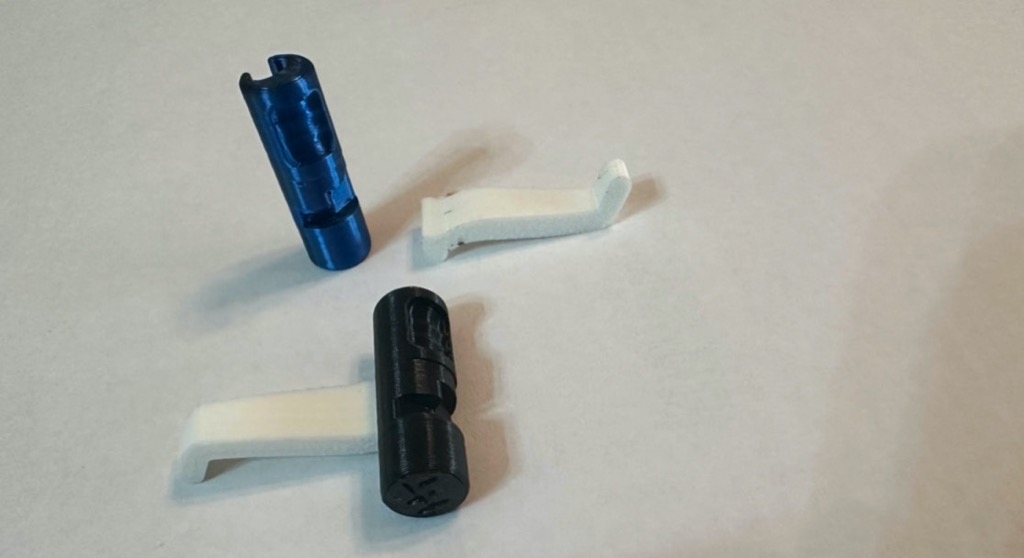
Demonstration prototypes, such as those printed in PLA plastic and shown in the article’s lead image, serve illustrative purposes only and would fail under live fire. The white lever fits into the colored cams, with ridged channels on the cam’s underside defining safety detents. A central angular shelf on the cam engages the trigger in the Super Safe mode to enforce resets. Once installed with hardened components, it delivers robust performance, albeit with the trade-off of adapting to a push-button safety-a shift from traditional thumb selectors that demands retraining for experienced AR users.
Despite this, the Super Safety was selected for several compelling reasons, outlined below:
- Affordability: Open-sourcing by Hoffman has spurred a competitive market with multiple producers offering parts in diverse materials. Avoid cheap, unheat-treated knockoffs from unverified Facebook sellers, which risk failure. The author’s D2 steel cam-and-lever sets cost around $75 each-far below alternatives. Cash purchases from trusted contacts, like a former colleague’s CNC operation, enhance discretion amid evolving legal landscapes. Numerous vendors match these prices. Hoffman himself sold units briefly after years of free files but paused due to patent litigation. Support him when possible, or fabricate your own if equipped. Open-source ethos empowers users this way.
- Open-Source Accessibility: Low entry barriers foster vibrant online communities on forums, Odysee, YouTube, and Reddit archives, rich with troubleshooting resources. Adaptations extend to MP5 variants, AR-10s, M249S prototypes, and even semi-auto M240 efforts. Surging interest in belt-fed AR-15s ties directly to its popularity, though budget constraints limit the author’s exploration.
- Durability and Design Simplicity: Unlike bump stocks or hellfire gimmicks, which the author avoided due to added complexity, the Super Safety integrates cleanly. It surpasses illegal modifications like third-hole drilling for full-auto packs or drop-in autosears in elegance. While Rare Breed offers proven reliability at higher cost and intricacy (with extra springs and parts), the Super Safety relies on just two rugged steel pieces-or viable alternatives like 3D-printed PA12CF nylon (hundreds of rounds viable) or bronze castings (untested). Beware biased short-form reviews pushing sales; seek thorough tests. BrassFacts’ channel stands out, demonstrating a stainless steel unit enduring over 3,000 rounds in standard AR-15s and Fightlite MCR belt-feds with excellent outcomes.
- Privacy Advantages: Home fabrication or cash transactions minimize traces.
- Premium Trigger Compatibility: Unlike full replacement FRTs, it pairs with high-end Geissele triggers via simple tweaks, preserving preferred feel and quality.
This concludes the foundational overview and rationale for choosing the Super Safety. Subsequent sections will detail installation procedures and operational verification, focusing exclusively on a standard 5.56mm AR-15 setup. While MP5 and AR-9 variants are prevalent, they demand additional components and nuances. Mastering the 5.56 installation builds essential familiarity as the simplest entry point.
Installation and testing instructions continue in Part 2.